


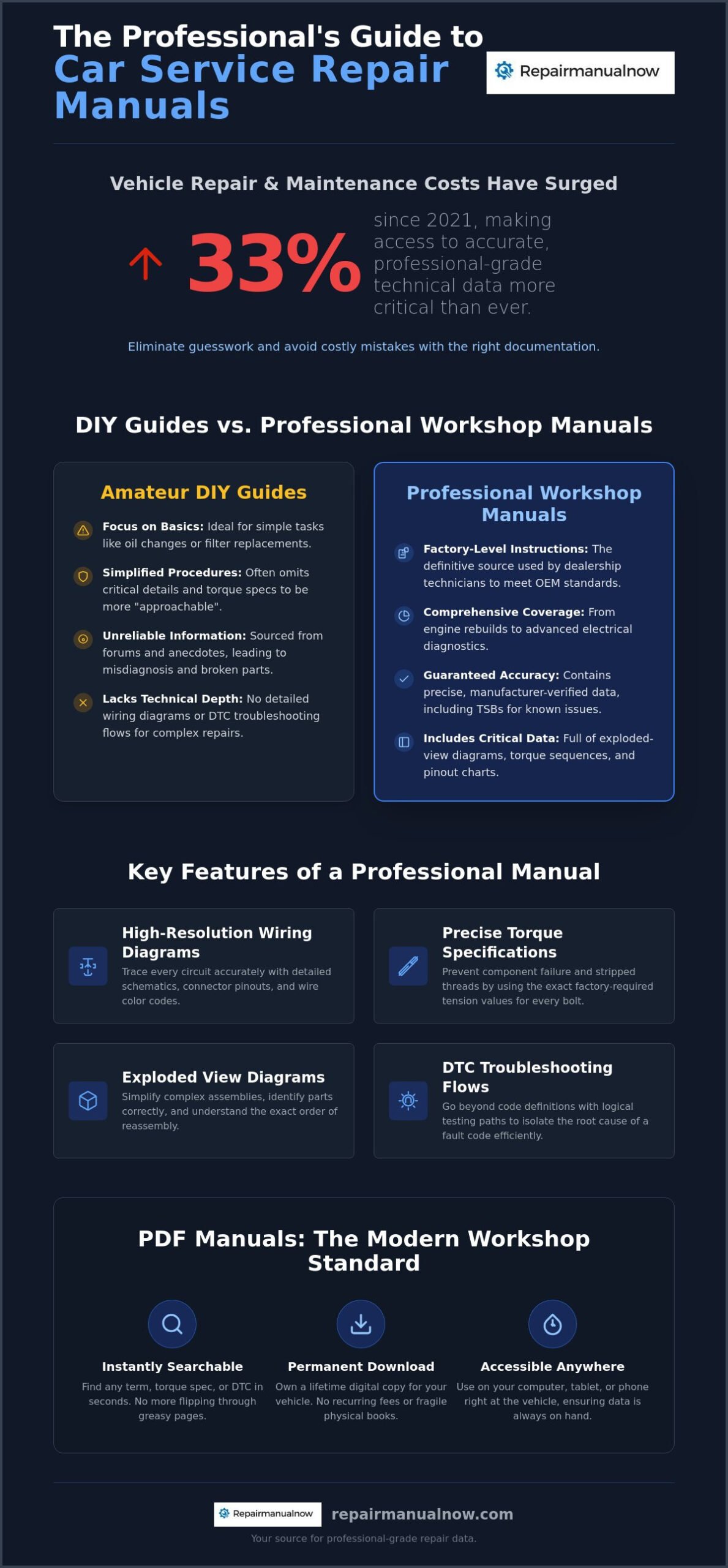
Vehicle repair and maintenance costs have surged by 33% since 2021, making the accuracy of your car service repair manuals more critical than ever. You understand that guessing at a bolt torque or squinting at a blurry, third-generation PDF scan is a recipe for stripped threads and electrical shorts. It’s frustrating to waste hours on unreliable forum advice that leads to broken parts and avoidable shop visits. You need technical accuracy, not amateur anecdotes from a message board.
Master your vehicle repairs with professional-grade technical data that eliminates the guesswork. This guide shows you how to utilize authentic documentation to access the precise torque sequences and complex wiring diagrams used by industry experts. We’ll examine the specific benefits of high-resolution schematics and OEM-level data. You’ll learn how to navigate these technical resources to ensure a successful first-time repair while avoiding expensive dealership labor costs. Stop searching for answers and start fixing with the same precision and speed used in professional workshops. Get the exact data you need to return your vehicle to the road with total confidence.
Key Takeaways
- Distinguish between generic “how-to” guides and professional-grade workshop manuals to ensure your repairs meet factory standards.
- Master complex electrical systems by utilizing high-resolution wiring diagrams and precise diagnostic trouble code (DTC) troubleshooting flows.
- Reduce workshop downtime with the instant searchability and immediate access provided by digital car service repair manuals.
- Secure the correct technical data by verifying your vehicle’s exact engine displacement and transmission type before beginning work.
- Avoid recurring fees and fragile physical copies by opting for a permanent PDF download that serves as a lifetime resource for your vehicle.
What defines a professional car service repair manual?
A professional car service repair manual is a comprehensive technical blueprint. It isn’t a simplified guide designed for casual reading. It provides the exact factory-level instructions required to maintain a vehicle’s mechanical and structural integrity. These documents, often referred to as Factory service manuals (FSM), are the definitive source of truth for any technician. They ensure that every repair meets the original manufacturer’s standards, which is vital for both safety and long-term performance. When you use authentic car service repair manuals, you aren’t just following a tutorial; you’re executing a precise engineering protocol that protects your vehicle’s resale value.
Professional mechanics also rely on Technical Service Bulletins (TSBs) included within high-grade documentation. These bulletins provide critical updates on known factory defects or improved repair procedures developed after the vehicle left the assembly line. Relying on outdated or generic information can lead to misdiagnosis, causing you to replace functional parts while the actual fault remains. Authentic documentation eliminates this risk by providing the most current data available from the manufacturer.
The difference between DIY guides and workshop manuals
DIY guides usually focus on routine maintenance like oil changes, spark plug replacements, or basic aesthetic upgrades. They are written for beginners and often simplify complex procedures to make them more approachable. While helpful for basic tasks, they lack the depth required for major mechanical work. Workshop manuals cover engine rebuilds, transmission teardowns, and advanced logic testing. Generic manuals often fail during complex electrical troubleshooting because they don’t include specific circuit behaviors or voltage drop expectations. You need the specific documentation that accounts for every sensor, actuator, and control module in your specific drivetrain configuration.
Core components of high-quality documentation
Precision is the hallmark of professional-grade technical data. High-quality car service repair manuals must include specific elements that generic retail guides omit:
- High-resolution wiring diagrams: These include connector pinouts and wire colors to trace signals accurately through the entire electrical harness.
- Exploded view diagrams: These illustrations simplify parts identification and show the exact assembly order for complex components.
- Precise torque specifications: Every critical bolt has a specific tension requirement. Documentation provides these values to prevent component failure or stripped threads.
- Diagnostic Trouble Code (DTC) flows: These charts provide a logical path to identify the root cause of a fault code rather than just listing the code’s definition.
Having access to this level of detail transforms a frustrating repair into a methodical process. It allows you to work with the same speed and accuracy as a dealership technician without the associated labor costs.
Key technical features to look for in a service manual
Generic guides often leave you stranded when you move past basic oil changes. Professional grade car service repair manuals provide the granular data required for complex systems. You need more than just a list of steps; you need the engineering data that defines the vehicle’s operation. This includes step-by-step diagnostic trouble code (DTC) troubleshooting flows. Instead of simply identifying a “P0300” code, a professional manual provides a logical testing path to isolate whether the fault lies in the ignition coil, fuel injector, or a vacuum leak. This methodical approach prevents you from wasting money on parts that don’t need replacement.
Beyond diagnostics, look for comprehensive suspension and steering alignment data. This ensures your vehicle tracks straight and avoids premature tire wear after replacing control arms or tie rods. You must also have access to detailed fluid capacities and specialized tool requirements. Knowing exactly how much 75W-90 gear oil your differential requires, or that a specific job requires a thin-wall 14mm spark plug socket, prevents mid-repair delays. Following the manufacturer’s maintenance schedule is only possible when you have the exact specifications for every service interval.
Mastering electrical repairs with schematics
Modern vehicles are sensor-heavy environments where a single loose ground can trigger a dozen false fault codes. Clear wiring diagrams are essential because they allow you to identify ground points and harness routing without tearing the entire interior apart. A wiring schematic is the roadmap for electrical troubleshooting. Without this map, you’re essentially blind. Professional manuals provide connector pinouts, showing you exactly which voltage to expect at each wire. You can access these high-resolution professional-grade workshop manuals to stop the guesswork in your shop.
Mechanical precision: Torque and clearance specs
Guessing torque values on modern aluminum engine components is a fast way to ruin a cylinder head. You need exact values for head bolts, cam caps, and manifold fasteners to ensure proper sealing without stripping threads. High-quality car service repair manuals provide micrometer-level data, such as valve clearance and piston ring gap specifications, which are vital for engine overhauls. Use exploded view diagrams to verify the correct reassembly order. These visual aids show every washer, seal, and clip in its proper place, ensuring that your transmission or engine rebuild functions perfectly on the first start. Precision is the difference between a repair that lasts a decade and one that fails in a week.
Why PDF digital downloads are the modern workshop standard
Efficiency in the workshop is measured by how quickly you can move from diagnosis to repair. Traditional paper manuals are relics that slow you down. They get greasy, the pages tear, and they lack a basic search function. Digital car service repair manuals in PDF format solve these problems instantly. You can start your repair five minutes from now because there’s no waiting for a delivery truck or dealership counter hours. This immediate access is the hallmark of a modern, efficient workspace. It allows you to maintain momentum and complete jobs faster.
Portability is another decisive advantage. You can view high-resolution diagrams on a tablet or laptop directly under the hood. If you’re performing a messy task, print only the specific pages you need for that greasy job. You won’t worry about ruining an expensive book with oil stains. Digital car service repair manuals provide the durability that physical books lack because your master file remains clean and intact on your device. Once the work is done, you simply recycle the printed pages.
Digital searchability vs. physical indexing
Keyword searching drastically reduces diagnostic time in the shop. Instead of flipping through a 500-page index, use Ctrl+F to find specific fault codes or component locations instantly. A trained automotive technician knows that every minute spent searching for data is a minute not spent fixing the vehicle. Zooming into high-resolution diagrams provides better clarity than any printed page can offer. You can also manage a digital library of multiple vehicle manuals on one single device, keeping your shop organized and clutter-free.
The benefits of offline backups
Internet connectivity isn’t always reliable in a metal-clad workshop. Relying solely on cloud access can stall your progress if the network drops. Using USB flash drives for areas with poor internet ensures your technical data is always available. This local storage means your documentation is accessible even if a website goes down or a subscription expires. The Repair Manual Now USB delivery option provides a secure physical backup for your entire digital library. It ensures that your workshop remains productive regardless of your internet status. Having a permanent backup means you own the data forever without recurring fees.
How to choose the right manual for your vehicle
Accuracy starts before you pick up a wrench. You must identify your exact year, make, and model with absolute certainty. A manual for a 2.5L engine won’t provide the correct timing chain alignment or head bolt torque for a 3.6L variant. Verify your engine displacement and transmission type early to avoid catastrophic mechanical errors. Choosing the wrong technical data leads to stripped threads and incorrect sensor readings. Precision at the selection stage is the only way to ensure a successful repair.
Manufacturers frequently implement mid-year production changes. Check for VIN-specific documentation to account for these “early” versus “late” model year differences. Using data for an early-production brake system on a late-production vehicle can lead to incorrect part fitment and safety risks. You must also ensure you’re selecting a “Service and Repair” manual rather than a “Parts Only” catalog. While parts catalogs are useful for exploded views, they lack the diagnostic procedures and step-by-step assembly instructions found in professional car service repair manuals. You need the full technical protocol to complete a professional repair.
Matching manuals to engine and trim variants
Trim levels often dictate more than just interior comfort. They often include different suspension geometries or specialized electrical modules. A manual for a base 4-cylinder model may not help with a V6 variant’s specific cooling system routing or logic testing. Identifying production dates is critical for sourcing the right data. Always verify that your chosen car service repair manuals specifically cover your drivetrain and trim level to ensure technical accuracy. Don’t settle for generic data that ignores these critical engineering differences.
Broadening the scope: From cars to heavy machinery
Professional workshops often handle more than just passenger vehicles. Service manuals for tractors and construction equipment follow different documentation standards, focusing heavily on hydraulic pressures and structural load limits. If you manage a fleet that includes utility vehicles or farm equipment, you’ll need specialized forestry or material handling manuals. You can find comprehensive technical data for these machines in our Agriculture Repair Manuals section. Having a single, reliable source for all your equipment documentation keeps your shop organized and productive.
Access your specific technical data now at Repair Manual Now to ensure your next repair is performed with OEM-level precision.
Get instant access to professional-grade repair data
Stop relying on temporary access or blurry, incomplete scans. When you invest in professional car service repair manuals, you’re securing a permanent asset for your workshop. This is a one-time purchase. You own the PDF file forever. There’s no recurring subscription fee that cuts off your access when you need it most. You get instant digital delivery, meaning you won’t waste time waiting for a shipping carrier or dealership counter hours. You can download your data and get to work immediately, ensuring your vehicle doesn’t stay on the stands a minute longer than necessary.
Security is a non-negotiable standard in a professional environment. We provide secure, virus-free downloads to ensure your diagnostic laptops and tablets remain protected during every session. Authenticity is equally vital. You are accessing genuine technical data that mirrors the information used by factory-trained experts. This isn’t community-sourced guesswork. It’s the engineering-grade data required for precise component calibration and system resets. Using authentic car service repair manuals provides the relief of knowing your repair is based on fact, not trial and error.
The Repair Manual Now advantage
Our advantage lies in our comprehensive scope and commitment to quality. While competitors might limit you to older models or generic passenger cars, we provide access to a massive library covering cars, agriculture, and construction equipment. A one-time fee is the superior choice for DIYers and independent shop owners who want to build a permanent reference library. You won’t lose your wiring diagrams or torque sequences just because you didn’t pay a monthly bill. This model fosters true capability, allowing you to approach any mechanical challenge with the same data used by the lead technician in a specialized shop. You gain total control over your technical resources.
Start your repair today
Broken machinery costs time and money. Every hour your vehicle sits idle is an hour of lost productivity or missed opportunities. Don’t let a lack of information stand between you and a finished job. Take control of your maintenance schedule and stop the frustration of inaccurate forum advice or poor-quality scans. You have the tools; now get the technical roadmap required to use them effectively. Eliminate the downtime and return your vehicle to service with total precision. Access the data you need to succeed right now.
Find your car service repair manual now and secure the technical data you need to finish the job today.
Take Command of Your Vehicle Maintenance
You now have the framework to distinguish between amateur guides and professional-grade documentation. Precision in repair requires more than just tools; it demands the OEM-grade technical specs and high-resolution wiring diagrams found in authentic car service repair manuals. By choosing digital PDF downloads, you eliminate workshop downtime and gain the ability to search thousands of pages of technical data in seconds. Whether you’re troubleshooting a complex electrical fault or performing a complete engine overhaul, having the right data is the difference between a failed attempt and a successful fix.
Stop letting mechanical frustration stall your progress. Secure your technical resources now and experience the efficiency of having factory-level data at your fingertips. We provide an instant PDF download for immediate access, and we have USB flash drive shipping available for those who need a reliable offline backup in the shop environment. Get the exact specifications you need without the dealership wait times.
Download Your Professional Car Service Manual Instantly
Get to work with the confidence of a lead technician and return your vehicle to the road today.
Frequently Asked Questions
Where can I find my car service repair manual?
You can find your specific manual by browsing our digital library categorized by make, model, and year. We provide instant access to high-resolution car service repair manuals that cover everything from basic maintenance to complex engine overhauls. Simply select your vehicle manufacturer and drivetrain configuration to locate the exact technical documentation required for your shop. This ensures you have the correct data before you begin any mechanical work.
Are these the same manuals that dealerships use?
Yes, these are genuine workshop manuals containing the same OEM-level technical specifications used by dealership technicians. They include precise torque sequences, wiring diagrams, and diagnostic trouble code (DTC) troubleshooting flows. You’re gaining access to the same professional-grade data that allows authorized service centers to perform accurate, factory-standard repairs. This level of detail is essential for maintaining the mechanical integrity and resale value of your vehicle.
Can I download a repair manual for free?
While some forums offer free scans, these are often incomplete, outdated, or low-resolution files that can lead to mechanical errors. Professional-grade documentation requires a one-time purchase to ensure you receive a comprehensive, virus-free, and verified technical resource. Investing in an authentic manual prevents the risk of using inaccurate data that could cause expensive damage to your vehicle’s sensitive components. High-quality data is a tool you shouldn’t skip.
What is the difference between a service manual and an owners manual?
An owners manual provides basic operation instructions like seat adjustments and oil types, while a service manual is a deep-dive technical guide for mechanical repairs. Service manuals provide the granular data needed for teardowns, such as valve clearances and piston ring gaps. You need a service manual for any task that involves tools beyond a simple tire gauge. It’s the difference between knowing how to drive and knowing how to fix.
Will a PDF manual work on my phone or tablet?
Yes, our PDF manuals are fully compatible with all modern smartphones, tablets, and laptops. This portability allows you to bring high-resolution wiring diagrams and exploded views directly to the vehicle. You can zoom in on complex schematics for better clarity or print specific pages to keep your digital device away from grease and shop fluids. This flexibility makes digital car service repair manuals the superior choice for a productive workshop environment.
What if I need a manual for a tractor or excavator?
We offer a massive library that extends beyond passenger vehicles to include agriculture and construction equipment manuals. You can find technical documentation for heavy machinery, forestry equipment, and material handling tools in their respective categories. These manuals provide the same level of professional detail, including hydraulic pressures and structural load limits. Having a single source for all your equipment documentation keeps your maintenance schedule organized and your fleet running efficiently.
How do I find my vehicle’s specific engine code for the manual?
You can locate your engine code on the vehicle’s emission control information label, usually found under the hood or on the driver-side door jamb. This code is critical for selecting the correct manual, especially for models with multiple engine variants. Checking your VIN is another reliable way to identify mid-year production changes. This step ensures your technical data matches your specific drivetrain, preventing fitment issues and incorrect torque applications.
What happens if I lose my downloaded manual file?
We recommend keeping a backup of your file on a local drive or opting for our USB flash drive delivery for offline shop use. If you lose your digital copy, you can contact our support team to verify your purchase and restore your access. Having a permanent backup ensures that you own the technical data forever without needing to pay for a recurring subscription. It’s a secure way to build a lifetime technical library for your workshop.