

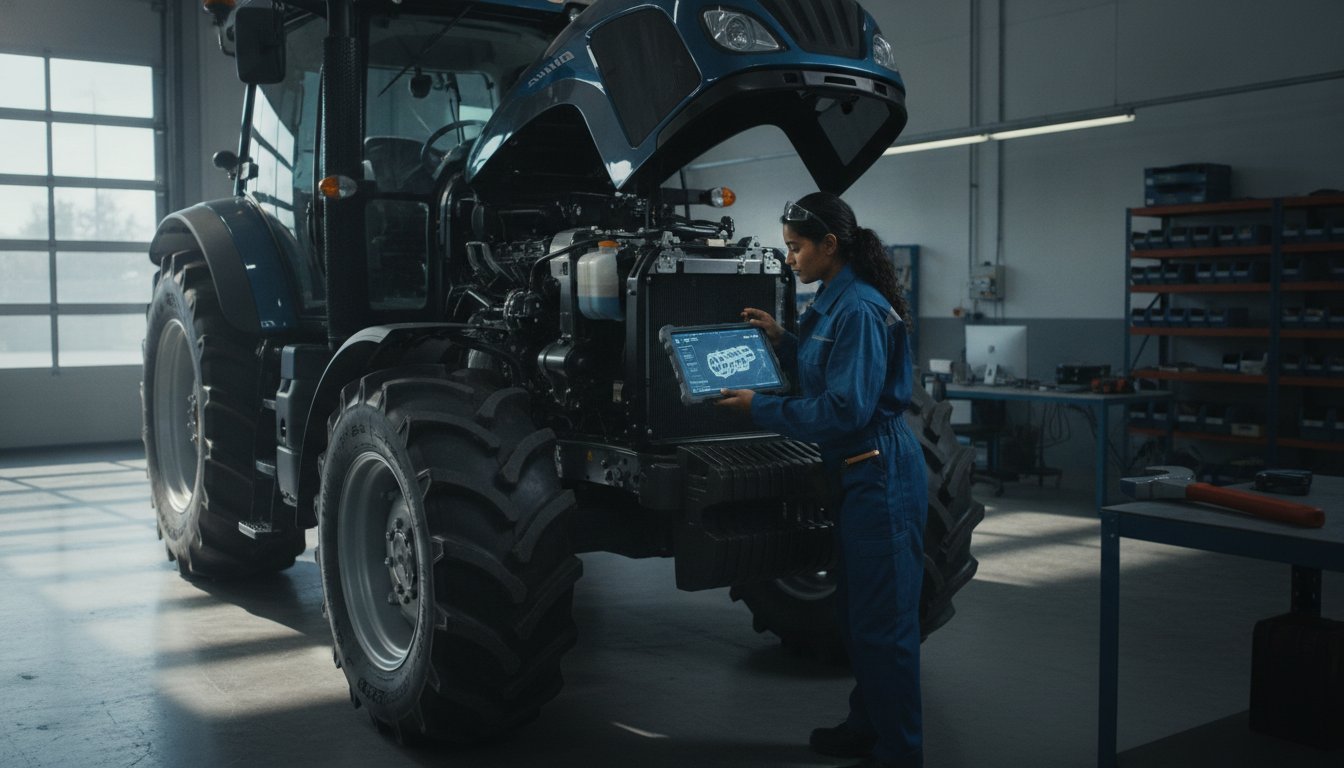
In 2026, the most valuable tool in your shop isn’t a torque wrench; it is the digital precision of professional agriculture repair manuals. For years, manufacturers held the keys to your equipment, forcing you to wait for dealership technicians while your crops sat in the field. That era is over. Recent federal settlements and state laws like Florida’s Fair Repair Act now guarantee your right to the same diagnostic data and schematics used by authorized dealers. You don’t have to settle for blurry, incomplete scans or pay thousands in service fees just to clear a simple sensor code.
You already know that every hour of unplanned downtime during peak season is a direct hit to your bottom line. It’s exhausting to watch a $3,348 seasonal loss mount while you wait for a service truck that might not arrive for days. This guide shows you how to take command of your fleet using high-resolution, instant-download documentation. We will cover how to leverage these professional-grade resources to perform complex engine rebuilds, troubleshoot intricate electrical systems, and keep your operational overhead at a minimum. Prepare to transform your workshop into a fully self-sufficient repair hub.
Key Takeaways
- Access comprehensive technical blueprints that include precise torque values, fluid capacities, and step-by-step overhaul instructions for engines and transmissions.
- Learn how to identify the exact documentation you need by locating your machinery’s specific make, model, and serial number prefix.
- Eliminate hours of manual searching by utilizing digital agriculture repair manuals that offer instant searchability for immediate diagnostic results.
- Reduce operational overhead and bypass expensive dealership service fees by performing professional-grade repairs in your own workshop.
- Gain immediate access to high-resolution wiring diagrams and schematics to resolve complex electrical failures without waiting for a technician.
The Critical Role of Agriculture Repair Manuals in Modern Farming
Agriculture repair manuals are the definitive technical blueprints for modern machinery service and overhaul. These aren’t just basic “how-to” guides; they provide the exact factory specifications, torque sequences, and electrical schematics required to keep high-horsepower equipment running. The industry has evolved rapidly from the days of greasy paper books that were easily lost or damaged. Today, high-definition digital interfaces provide immediate access to the same data used by factory technicians. This shift is a core component of the global Right to Repair movement, which has successfully pushed for greater transparency and accessibility in equipment maintenance.
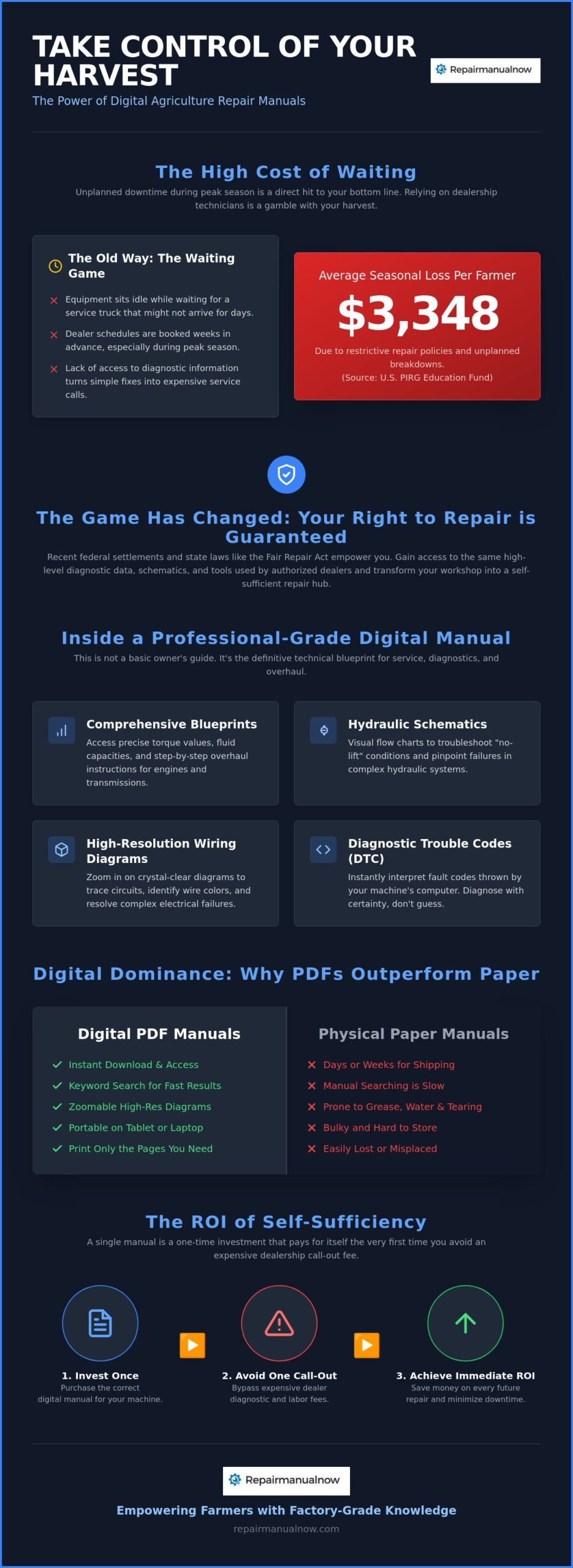
Relying on a dealership technician in 2026 is often a gamble with your harvest. When a tractor goes down in the middle of a planting window, the cost of waiting for a service truck can be devastating. Research from the U.S. PIRG Education Fund shows that restrictive repair policies and unplanned breakdowns cost farmers an average of $3,348 every season. By owning your own agriculture repair manuals, you move from being a “parts swapper” who guesses at a fix to a precision technician who diagnoses with certainty. You gain the power to clear codes, trace wiring faults, and perform internal engine repairs without external permission.
Why Dealership Reliance is a Profit Killer
Rising hourly labor rates at ag-repair shops have made even routine service calls a significant financial burden. The real danger, however, is the bottleneck of technician availability. During peak seasons, a dealership’s schedule is often booked weeks in advance. If you don’t have the documentation to troubleshoot a fault code immediately, your equipment sits idle while the weather window closes. Having the right manual allows for immediate troubleshooting. You can identify the failed component, order the part, and complete the installation before a dealer even returns your call.
The ROI of Investing in Professional Documentation
The return on investment (ROI) for professional documentation is realized the first time you avoid a dealer call-out fee. In the context of farm equipment maintenance, ROI is the ratio of the net profit gained from reduced downtime and avoided labor costs relative to the initial cost of the manual. Beyond immediate savings, using factory-accurate specs increases equipment lifespan by ensuring every bolt is torqued correctly and every fluid is changed at the precise interval. A single manual is a one-time investment that protects a machine worth hundreds of thousands of dollars. It’s the most cost-effective insurance policy against operational delays.
What Is Inside a Professional-Grade Agriculture Service Manual?
Professional-grade agriculture repair manuals are far more than simple maintenance guides; they are the exhaustive workshop references used by factory-trained technicians. While an operator manual explains how to check fluid levels or attach an implement, a service manual provides the internal tolerances for an engine rebuild and the specific pressure settings for a hydraulic pump. These documents contain the Diagnostic Trouble Code (DTC) tables required to interpret modern electronic failures. Modern tractors are rolling data centers. When a machine throws a code, you don’t have to call the dealer to find out what it means. You look it up, identify the circuit path, and fix it yourself.
Hydraulic and Electrical Schematics: The Core of Repair
Visual flow charts are the backbone of troubleshooting “no-start” or “no-lift” conditions. Modern machinery relies on complex sensor networks and ISOBUS integrations that are impossible to trace by eye. High-resolution PDF manuals allow you to zoom into circuit labels and wire colors without losing clarity, which is a critical advantage over low-quality scans. This level of transparency is supported by recent EPA guidance on Right to Repair, which emphasizes the farmer’s right to access the software and hardware data needed for emissions-related and mechanical repairs. Having these schematics means you can pinpoint a broken ground wire or a failed solenoid in minutes instead of hours.
Distinguishing between an operator manual and a full workshop service manual is vital for any serious repair. A workshop manual includes detailed system testing procedures and calibration steps that are never found in the glovebox booklet. This includes the precise voltage ranges for sensors and the step-by-step logic used by the on-board computer to manage engine timing. Before you begin any electrical diagnostic, ensure you have the proper workshop documentation to avoid damaging sensitive electronic control units.
Teardown and Rebuild Specifications
Major mechanical failures require more than just a set of wrenches. You need the exact torque values for cylinder head bolts and the specific shim thicknesses for final drive assemblies. Professional documentation provides sequence diagrams for complex components like power-shift transmissions, ensuring you don’t miss a single snap ring or thrust washer during reassembly. These diagrams show the exact orientation of every gear and bearing, which is essential when working on equipment that has been out of production for years.
Safety protocols are integrated throughout these sections, detailing how to safely discharge high-pressure hydraulic accumulators or lift heavy castings. You’ll also find lists of specialized tools required for specific tasks, allowing you to source or fabricate what you need before the machine is in pieces on the shop floor. Following these factory specifications ensures the machine returns to service with the same reliability it had when it left the assembly line. It’s the only way to guarantee that a major repair actually lasts through the next harvest season.
Choosing the Right Manual for Your Tractor or Harvester
Selecting the correct documentation requires more than just knowing your tractor’s color or brand. Precision is the standard. If you order a manual based on model name alone, you risk receiving instructions for a machine with entirely different hydraulic pump configurations or wiring harnesses. Manufacturers frequently implement mid-generation updates that change internal components without changing the model number on the hood. To ensure you have the exact agriculture repair manuals required for your specific machine, you must verify the Make, Model, and Serial Number prefix before finalizing your search.
You also need to distinguish between the three primary types of documentation. An Operators Manual covers basic controls and daily maintenance. A Parts Manual provides exploded views and OEM part numbers, which is vital for ordering components. However, for actual repair work, you need the Service or Workshop Manual. This is the comprehensive guide that details teardown, troubleshooting, and reassembly. For machines with third-party powerplants, always check for engine-specific supplements. A chassis manual for a versatile tractor might not include the deep-dive data needed for the Cummins engine sitting under the hood.
Navigating Brand-Specific Documentation
Each manufacturer uses a proprietary system for organizing their technical data. John Deere, for example, utilizes a specific Technical Manual (TM) numbering system. A “TM” manual is the professional workshop resource, while an “OM” is for operators. Understanding these designations prevents you from buying a basic user guide when you actually need a deep-dive diagnostic tool. Case IH and New Holland often share platform architectures but maintain distinct manual structures and wiring color codes. Never rely on “Generic” or “Universal” manuals. Modern ag-machinery is too complex for one-size-fits-all instructions; using the wrong torque spec on a high-pressure common rail fuel system can lead to catastrophic component failure.
Verifying Serial Number Compatibility
The serial number plate is usually located on the main frame rail, the rear axle housing, or the engine block. Locate this plate and record every character. This string of numbers and letters is your only protection against ordering a manual for the wrong “Series” of a model. Serial number accuracy is the single most important factor in manual selection because it accounts for every engineering change made during the production run. The legal landscape has shifted to support this level of precision. Colorado’s Right to Repair law was a landmark victory that helped force manufacturers to make these specific, serial-matched resources available to owners and independent shops. Don’t guess. Match your serial number to the manual’s coverage range to ensure every schematic and specification in the document applies to the machine sitting in your shop.
Digital PDF vs. Physical Manuals: Why Speed and Searchability Win
Physical books are a liability in a modern workshop. They are heavy, they get covered in hydraulic fluid, and they are impossible to update once they leave the printer. In 2026, agriculture repair manuals are digital tools designed for the speed of the field. The primary advantage is instant access. When a harvester stops in the middle of a row, you don’t have time to drive back to the shop or wait for a mail carrier. You download the PDF and start diagnosing immediately. This “Fix It Now” capability is the difference between losing a day of productivity and finishing the field before sunset.
Searchability changes everything. Instead of squinting at a manual table of contents, use the “Ctrl+F” function to find specific keywords like “injector timing” or “main bearing clearance” in seconds. This turns a 2,000-page document into a searchable database. You can carry the entire technical library for your fleet on a smartphone or tablet. This portability ensures that the technical specifications are exactly where the repair happens, not left on a desk miles away. Digital files are also immune to the shop environment. They don’t tear, they don’t get lost, and they stay pristine regardless of how much grease is on your hands.
The PDF Advantage in the Workshop
Working with a digital file allows you to print only the specific pages required for a particular job. If you’re performing a messy transmission overhaul, print the relevant assembly diagrams and discard them when the job is done. This keeps your master copy clean and accessible. High-resolution PDF files also support extreme zooming. You can enlarge complex exploded views to identify the smallest snap rings or shims, which is often impossible with the fixed scale of a printed book. These files are fully compatible with all modern devices, including iOS, Android, and Windows, ensuring you always have a viewing platform available in the cab or the shop.
USB Flash Drives: The Ultimate Offline Backup
Internet connectivity is often unreliable in remote rural areas. If your shop is in a dead zone, relying solely on cloud access is a risk you can’t afford. Physical digital backups on USB flash drives provide the security of having a permanent, offline copy of your technical data. This ensures you can access your agriculture repair manuals even during a total network failure. These drives are delivered as secure, virus-free resources, offering a professional-grade alternative to standard downloads for those who prefer a physical backup in their toolbox.
Don’t let poor connectivity or a ruined book stop your progress. Secure your digital agriculture repair manuals today and keep your shop running at full capacity.
Get Back to Work: Instant Access to Agriculture Repair Manuals
When you’re in the middle of a breakdown, you don’t need a sales pitch; you need a solution. Repair Manual Now provides exactly that. Our agriculture repair manuals are the same high-level resources used by dealership service departments. We eliminate the uncertainty of third-party forums and low-quality scans. Every file is verified as genuine, up-to-date, and completely virus-free. This isn’t just about providing a document. It’s about providing the confidence to dismantle a high-value piece of machinery and put it back together correctly.
Genuine Documentation You Can Trust
Professional mechanics avoid “free” manual sites because the risk of malware or incomplete data is too high. A missing page in a wiring schematic or an incorrect torque specification can lead to a catastrophic failure that costs thousands. We source our documentation directly to ensure every circuit label and hydraulic path is accurate. This commitment to precision is what makes us a preferred partner for independent shops and owner-operators alike. You get the peace of mind that comes with manufacturer-sourced data without the dealership overhead. Browse Agriculture Repair Manuals to find the specific technical blueprints for your fleet.
Navigating our catalog is designed for speed. You can filter by equipment type, manufacturer, and model series to pinpoint your exact manual in seconds. Once you’ve verified your serial number compatibility, the checkout process is streamlined for efficiency. From the moment of payment to the instant download link appearing in your inbox, the entire transaction takes under 60 seconds. We know that every minute spent staring at a computer screen is a minute you’re not in the field. If you’re working on a rare or legacy machine that isn’t listed, our support team specializes in tracking down hard-to-find documentation to ensure no machine is left behind.
Immediate Solutions for Field Failures
The 2026 agricultural landscape demands self-sufficiency. With state and federal laws now protecting your right to access this data, there is no reason to remain tethered to a dealer’s schedule. We maintain a “get-to-work” attitude that prioritizes utility over fluff. You get the facts, the diagrams, and the specs you need to resolve failures immediately. Don’t let a $3,348 seasonal loss become your reality. Stop the downtime that drains your profits and take full control of your equipment maintenance strategy today. Download your agriculture repair manual now and get back to the work that matters.
Take Command of Your Fleet Maintenance in 2026
The landscape of farm equipment maintenance has shifted permanently in your favor. Federal and state regulations now mandate that you have access to the same technical data used by authorized dealers. You don’t need to wait on a dealership’s schedule to keep your operation moving during peak season. By utilizing professional-grade agriculture repair manuals, you secure the exact torque specs, wiring diagrams, and diagnostic codes required for successful DIY repairs. This transition from dealer reliance to shop-floor independence is the single most effective way to protect your bottom line from the high costs of unplanned downtime.
You need immediate solutions, not empty promises. We provide high-resolution, genuine manufacturer data with a virus-free guarantee. Our platform ensures you get instant digital access to the technical blueprints that matter most. Stop gambling with your harvest windows and start fixing your machinery on your own terms. Your shop is ready and your tools are waiting. Now, you finally have the data to finish the job.
Download Your Professional Agriculture Repair Manual Now
Frequently Asked Questions
Are these the same manuals used by dealership technicians?
Yes, these are the genuine workshop service manuals containing the same factory-level specifications and diagnostic procedures used by authorized service centers. They provide the precise torque values, tolerances, and calibration steps required to return your machinery to OEM standards. You are gaining access to the professional-grade data necessary for complex engine and transmission overhauls.
What happens if I lose my downloaded PDF file?
Contact our support team immediately to have your download link reactivated. We maintain a secure record of your purchase to ensure that hardware failures or lost devices don’t result in a loss of your technical data. For maximum security, many operators choose our optional USB flash drive delivery to maintain a permanent offline backup in their shop.
Will the manual include wiring diagrams and hydraulic schematics?
Comprehensive agriculture repair manuals always include high-resolution wiring diagrams and hydraulic schematics. These visual flow charts are the core tools needed for troubleshooting “no-start” conditions or hydraulic pressure failures. The digital format allows you to zoom in on specific circuit labels and wire colors without the blurriness found in low-quality scans.
Can I print the pages from the PDF manual?
Yes, all our digital manuals are fully printable. You can print specific pages or entire sections to take directly into the workshop, allowing you to keep your master digital copy clean and grease-free. This is particularly useful for referencing assembly sequences or bolt patterns while working under the machine in the field.
What if I can’t find my specific tractor model in your catalog?
Submit a request through our contact page if your specific model is not currently listed. Our catalog is extensive and includes documentation for many rare or legacy machines that may not be indexed in the main search results yet. We prioritize sourcing hard-to-find technical data to help you keep older equipment in service.
Do I need special software to open the agriculture repair manuals?
No specialized software is required to open our agriculture repair manuals beyond a standard PDF reader. These files are designed for universal compatibility across all modern devices, including Windows PCs, Macs, iPhones, and Android tablets. You can begin navigating the technical data immediately after your download is complete.
Is it safe to download these manuals to my computer or tablet?
Yes, every file we provide is guaranteed to be genuine and virus-free. We use secure, encrypted servers to protect your information and ensure that the technical documentation you receive is safe for your hardware. You are getting professional-grade resources from a reliable partner focused on immediate technical solutions.
How do I receive the USB flash drive version of the manual?
Select the USB delivery option during the checkout process to receive a physical backup of your documentation. We ship a professional-grade flash drive containing your specific files directly to your location. This is the ideal solution for farms with poor internet connectivity or for those who want a durable, offline reference in their toolbox.